
stable signals, predictable performance, sensing accuracy you can trust in any environment.
Spun & PM Fibers for High-Precision Sensing Applications
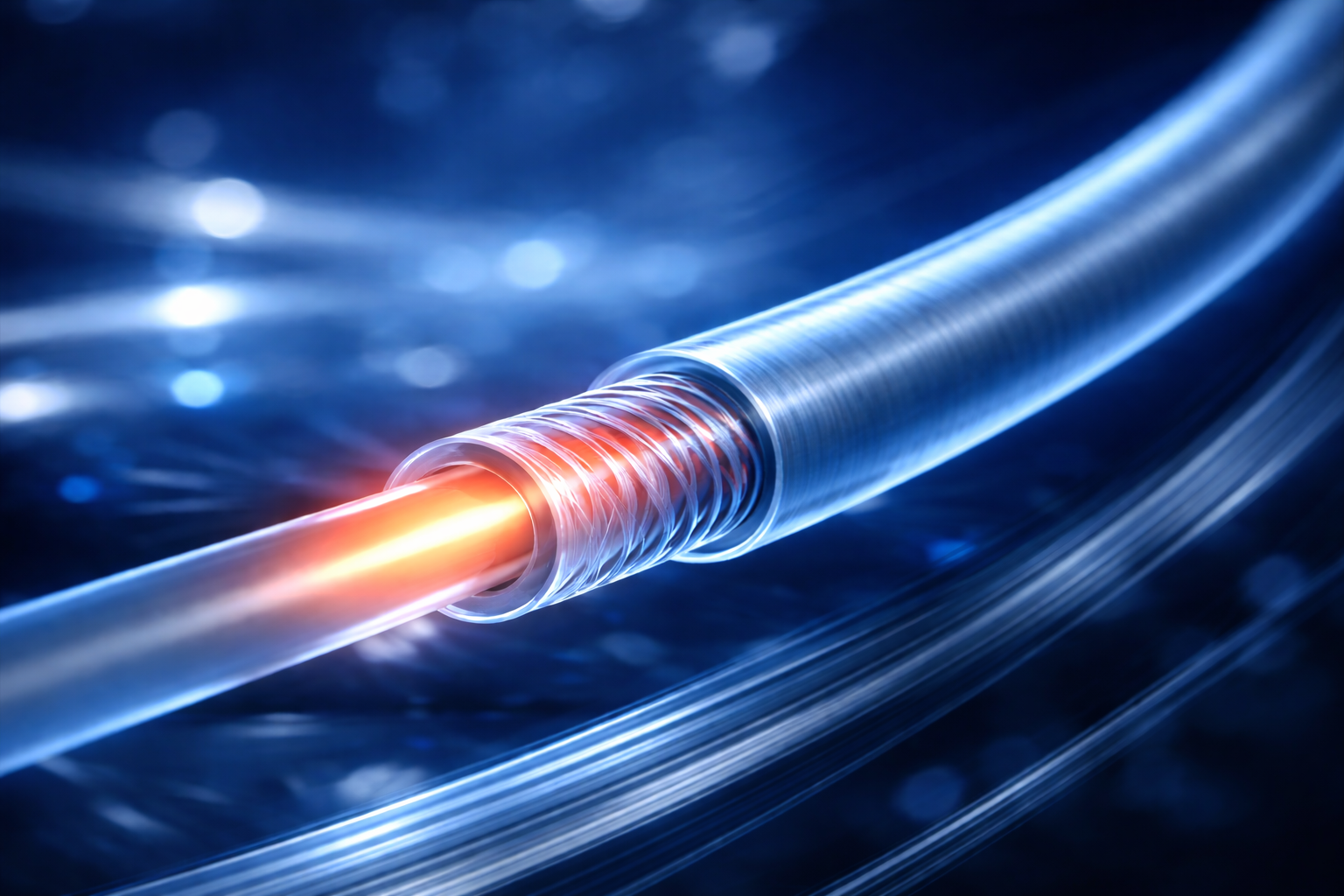
Low-birefringence optical fiber, also known as spun fiber, transmits polarized light over long distances with minimal error. Unlike standard PM fibers, it supports both linear and circular polarization and does not require axial alignment during splicing or connectorization. This performance comes from a precisely controlled helical twist introduced during manufacturing. The spun structure distributes silica non-uniformities in all directions, which cancels overall fiber birefringence, reduces polarization sensitivity, and limits environmental noise.
This optical stability makes spun fiber a strong fit for distributed sensing, vibration monitoring, and structural health diagnostics, including use in harsh industrial settings. Tight control over the drawing process, twist uniformity, and fiber geometry delivers consistent signal behavior and mechanical reliability across long lengths and demanding operating conditions.
Key advantages:
- Reduced polarization mode dispersion (PMD)
- Improved signal-to-noise ratio
- Higher mechanical durability
- Superior performance in distributed acoustic and temperature sensing systems
Why Spun Fiber Is the Industry Standard for Advanced Sensing
Spun fiber is the foundation of modern distributed sensing technology because it stabilizes optical behavior under real-world operating conditions. It delivers consistent performance where temperature gradients, vibration, and pressure fluctuations would normally degrade standard fiber accuracy.
Ideal for:
Precision Twist Control
Our spun fibers are manufactured with digitally regulated spin profiles that ensure uniform polarization averaging and consistent sensing behavior along the entire fiber length.
Certified Specialty
Fiber Manufacturing
All spun fibers are produced under strict quality systems with optional optical characterization, material certification, and full batch traceability scientific compliance.
Engineered for Predictable Performance
Every meter of our spun fiber is produced under digitally controlled manufacturing parameters that regulate twist rate, geometry, and material consistency. Inline monitoring ensures that fiber polarization properties and mechanical performance remain stable from prototype batches to kilometer-scale production.
This guarantees:
Spun Fiber Specifications Overview
Spun fiber is produced by introducing a precisely controlled rotational twist during fiber drawing. This process transforms conventional optical fiber into a mechanically stabilized and polarization-robust platform ideal for advanced sensing technologies.
Available Fiber Types
-
Single-mode spun fiber for DAS/DTS
-
High-strength spun fiber for harsh installations
-
Spun fiber with metal or specialty coatings
-
Custom twist rates and geometries
Technical Performance Summary
| Parameter | Spun Fiber Specification |
|---|---|
| Fiber Structure | Helically spun single-mode optical fiber |
| Twist Rate Range | Customizable: 5 to 40 turns per meter |
| Operating Temperature | −60 °C to +300 °C (higher with metal coatings) |
| Polarization Stability | Ultra-low polarization sensitivity |
| Tensile Strength | > 450 MPa after spinning process |
| Bend Radius | ≥ 20× fiber diameter |
| Optical Attenuation | ≤ 0.22 dB/km @ 1550 nm |
| Mechanical Fatigue Resistance | Enhanced vs standard fibers |
| Chemical Resistance | Compatible with industrial oils and solvents |
| Coating Options | Polyimide, metal, custom composite layers |
| Length Availability | Prototype meters to multi-kilometer reels |
| Dimensional Tolerance | ±0.5 μm standard |
| Production Traceability | Full material and process documentation |
FAQ’s
Low-birefringence optical fiber is produced by spinning fiber preform during drawing. That way all preform non-uniformities are spread out around all directions. As a result all polarization errors (retardations) accumulated by the propagating signal cancel each other out.
Highly birefringent fibers, such as Panda or Bow-tie maintain only linear polarization, while low-birefringence spun fiber maintains both linear and circular polarization states. Also because of spun fiber’s uniformity there’s no need to align the fiber when coupling light in our out.
No, proper fiber orientation is not critical to polarimetric accuracy when using low-birefringent fiber.
High local (internal) birefringence is created in spun fiber by creating stress in the cladding or employing elliptical core. This high birefringence negates other pressure or bend-induced polarization effects, but since its axis is rotated uniformly it introduces virtually no error into output signal.
Spun fiber preform is rotated during drawing, so the fiber cools down without residual torsional stress. Twisting the fiber after drawing results in similar polarization-maintaining qualities, and both types of fiber can be used to produce fiber-optic components, such as chiral fiber polarizers.
No. Fiber high local birefringence makes it insensitive to other stress-induced effects.
Spun fiber’s bend tolerance is determined largely by its diameter, beat length and pitch. Fibers with 5mm beatlength can be bent into 1cm coils without introducing unwanted birefringence.
There is a balance between fiber bend tolerance and accuracy. Fibers with short beat length can withstand significant bends but high internal birefringence will introduce small retardation error. Longer beat length fibers are more sensitive to bending but provide better accuracy.
Pitch (spin period) is the longitudinal period of fiber rotation. It is beneficial to have pitch as short as possible to achieve quality averaging.
While there is no reliable way to measure pitch through polarimetry, but it can be estimated by inspecting stripped parts of the fiber.
Low-birefringence fibers can be spliced, cleaved and terminated in exactly same way as the regular telecom fibers.
Yes, we can terminate low-birefringence fibers with most fiber-optic connectors.
It is certainly possible to arrange a custom draw of low-birefringence fiber. In fact, most of our spun fibers are tailored to a specific device or aplication. Options include optimized beat length, specific wavelength cut-off, reduced cladding and polyimide coating.
