
where failure is not acceptable.
Metal Coated Fiber for Extreme Environments
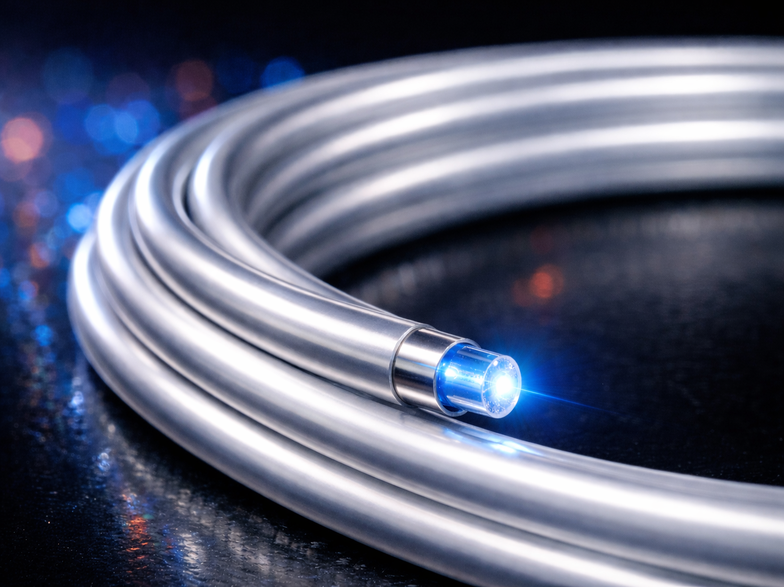
Metal coated fiber is the industry standard for optical systems that operate where polymer coatings fail. We offer single-mode and multimode fibers with high-temperature aluminum or copper alloy coatings applied as a thin, continuous metal layer directly on the glass surface. This metal layer adds mechanical strength, eliminates outgassing, improves heat transfer, and extends the operating temperature range to 600 °C or higher, depending on heating patterns and atmosphere composition. These fibers also deliver strong cost performance compared to gold-coated alternatives.
The result is a rugged, thermally stable, and contamination-free optical component built for demanding scientific and industrial use. Our metal coated fibers are trusted in high-vacuum chambers, semiconductor fabrication, aerospace research, particle accelerators, oil and gas instrumentation, and advanced sensing platforms where reliability is mission-critical.
Precision Optical Fibers for Environments Where Polymer Coatings Fail
Metal coatings replace traditional polymers with a metallic barrier that provides:
-
Ultra-low outgassing
-
Superior thermal conductivity
-
High mechanical durability
-
Resistance to radiation and chemicals
-
Long-term dimensional stability
This makes metal coated fiber the preferred solution for:
-
High-vacuum and UHV systems
-
Temperatures above 600 °C
-
Chemically aggressive environments
-
Precision optical measurement systems
Why Metal Coated Fiber Is the Industry Standard
Unlike polymer coatings that soften, degrade, or outgas, metal coatings remain stable under extreme conditions. They maintain optical alignment, protect the glass from micro-cracks, and enable predictable system performance over long operational lifetimes.
Ideal applications include:
Precision Coating Control
Metal coating thickness is digitally regulated to ensure uniform thermal performance, adhesion strength, and mechanical protection along the entire fiber length.
Certified Specialty
Fiber Manufacturing
All production is executed under strict quality systems with optional vacuum compatibility testing, material certification, and inspection documentation.
Engineered for Predictable Performance
Our metal coating process uses digitally controlled deposition and inline inspection to guarantee consistent thickness, adhesion, and concentricity.
This approach ensures:
Metal Coated Fiber Specifications Overview
Metal coated fiber is produced by applying a continuous metallic layer directly onto the optical fiber surface, transforming it into a high-temperature, vacuum-compatible, and mechanically robust component.
Typical Coating Materials
-
Gold – Maximum corrosion resistance and vacuum purity
-
Aluminum – Lightweight with excellent thermal conductivity
-
Nickel – Superior mechanical strength and coating adhesion
-
Copper – Enhanced heat dissipation and electrical grounding
Technical Performance Summary
| Parameter | Spun Fiber Specification |
|---|---|
| Coating Type | Gold, Aluminum, Nickel, Copper |
| Coating Thickness | 5–50 µm (customizable) |
| Short-Term Temperature Peaks | Up to 700 °C (material dependent) |
| Outgassing Level | Ultra-low, UHV compatible |
| Tensile Strength | > 500 MPa after coating |
| Bend Radius | ≥ 20× fiber diameter |
| Thermal Cycling Resistance | Stable from −50 °C to +400 °C |
| Chemical Resistance | Resistant to solvents, oils, vacuum cleaners |
| Optical Attenuation Stability | No measurable drift in vacuum |
| Surface Cleanliness | Laboratory-grade contamination control |
| Production Traceability | Full material and batch traceability |
| Geometry Options | Single-core, spun, multi-core |
| Length Availability | Prototype to kilometer-scale production |
| Compliance Options | ISO manufacturing, vacuum test protocols |
