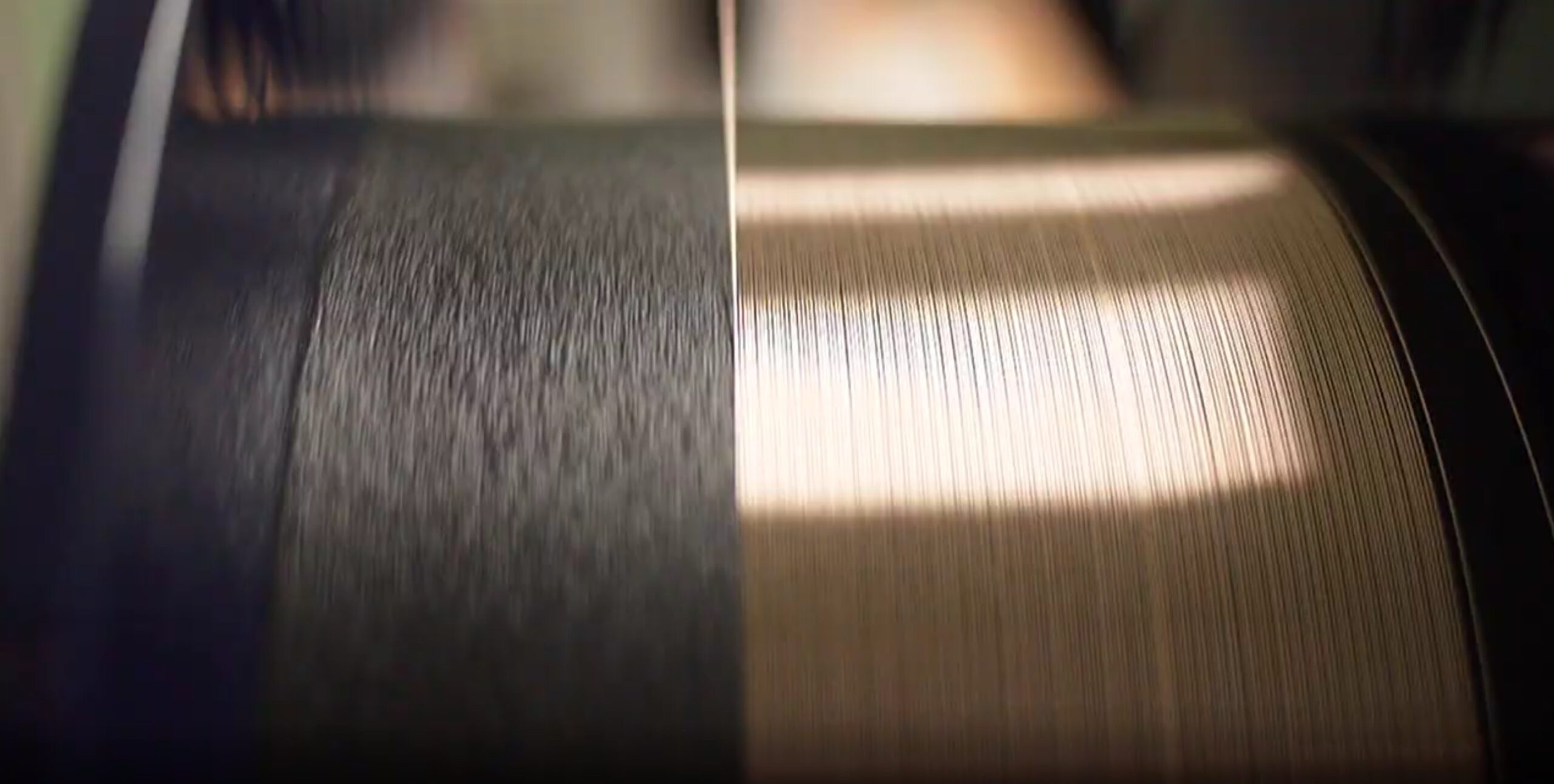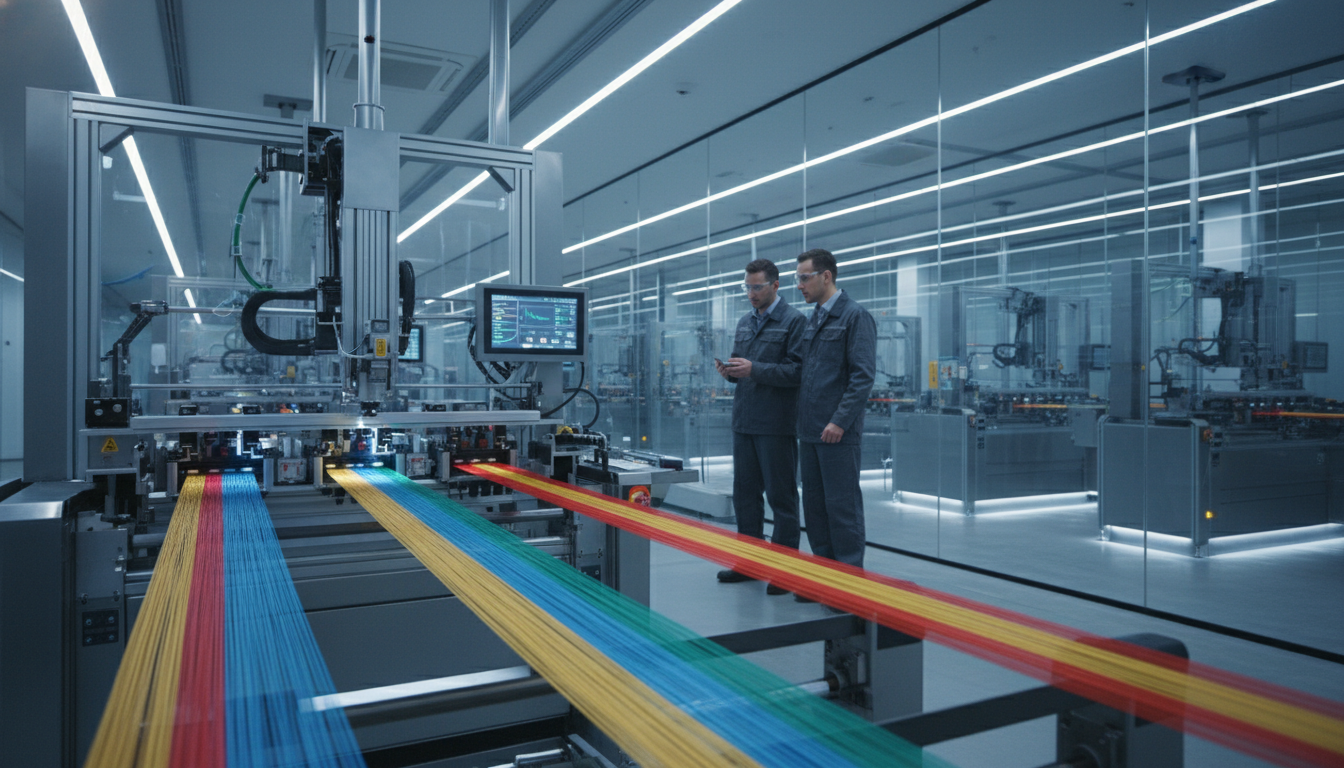
A modern fiber factory is at the forefront of technology. It makes optical components that power our connected world. These places use advanced engineering and strict quality control to make fibers that lose little light.
They have clean rooms, special equipment, and skilled workers. These workers know the complex physics of light transmission.
Advanced optical manufacturing is more than just making glass. Today, it creates fibers for many industries, like telecommunications and medical devices. Companies like Corning and OFS make single-mode fibers for internet data across oceans. Medical devices also use these fibers for endoscopes in surgeries at Mayo Clinic and Cleveland Clinic.
The fiber factory floor is unlike any traditional manufacturing plant. Workers wear special suits to avoid contamination. They watch as computer-controlled towers stretch molten glass into thin strands.
Each fiber must meet exact standards for size and quality. A small change can affect signal quality in networks run by AT&T or Verizon.
Precision manufacturing lets these facilities make specialty fibers with special properties. Some fibers have rare-earth elements like erbium for signal amplification in undersea cables. Others have special coatings for extreme temperatures in industrial lasers by IPG Photonics.
The optical fiber factory must adjust its methods for each use while keeping quality consistent.
Key Takeaways
- Specialty fiber factories need clean rooms and computer-controlled tools for quality
- Advanced optical manufacturing helps many industries, including telecommunications, medical devices, and lasers
- Precision ensures fibers meet tight standards for light transmission
- Big names like Corning and OFS lead in making top-quality optical fibers
- Different fibers need special making processes for their uses
- Quality checks at every step ensure products work well
The Role of Fiber in Optical Manufacturing
Optical fibers are key to today’s communication and industrial systems. They are thin strands of glass that help with internet and medical procedures. Each fiber has its own design and purpose in specialty manufacturing.
Modern fiber optics technology is used in many important areas:
- Telecommunications networks that connect billions of devices worldwide
- Data centers managing cloud storage and computing services
- Industrial fiber lasers used in metal cutting and welding operations
- Medical devices delivering laser energy for surgical procedures
- Sensing systems monitoring oil pipelines and structural integrity of bridges
The success of optical components relies on precise matching. Core diameter and numerical aperture must align to prevent signal loss. Different polishing techniques are used for fiber connectors.
Physical Contact (PC) and Ultra Physical Contact (UPC) polishes are common. But, systems sensitive to back-reflections need Angled Physical Contact (APC) connectors set at 8 degrees.
Working with optical fibers is challenging. Even microscopic dust particles can block or damage fibers. Each fiber has specific bend radius limits to avoid signal loss or breakage.
Standard telecom components handle power levels below 500 milliwatts. But, industrial applications might need high-power fibers.
Specialty fiber manufacturing is a precise science. Quality control is key to system performance.
What Makes Specialty Fibers Unique?
Specialty optical fibers are different from regular fibers. They can handle extreme conditions. These fibers have special coatings that keep working even in tough environments.
The making of these fibers includes adding cerium to the core. This helps prevent signal loss from high-energy particles. They work well from -40°C to +85°C, and some can go up to 300°C.
These fibers are needed for critical tasks. They offer unique features that regular fibers can’t match:
| Application | Temperature Range | Key Feature |
|---|---|---|
| Aerospace Engine Monitoring | Up to 300°C | Metal coating protection |
| Nuclear Power Plants | -40°C to +85°C | Radiation resistance up to 10 kGy |
| Geothermal Detection | Up to 250°C | Polymer heat shielding |
| Space Satellites | -60°C to +100°C | Particle bombardment resistance |
Designers focus on many aspects, like how light spreads and bends. These fibers are key in aerospace, nuclear, and space. They handle coating degradation and darkening effects that regular fibers can’t.
The Importance of Precision in Fiber Production
In a precision fiber plant, every detail counts. The success of optical components relies on exact specifications. These specifications affect how light travels through each fiber.
Manufacturing teams track key parameters to ensure each fiber meets strict standards. These standards are for telecommunications, medical devices, and sensing applications.
Quality control in fiber production involves many checkpoints. Each fiber is tested for wavelength range compatibility. This ensures it works as designed.
Fibers must stay single-mode at certain wavelengths. They also need to avoid excessive bend loss at higher limits.
Optical measurement systems are key in checking fiber performance. They verify if fibers match in mode field diameter. If not, signal loss can be too high.
These systems also check insertion loss values at connector points. They ensure return loss specifications are met. This prevents laser instability.
| Measurement Type | Acceptable Range | Impact on Performance |
|---|---|---|
| Insertion Loss | 0.1-0.5 dB | Signal strength preservation |
| Return Loss | >50 dB | Laser stability maintenance |
| Mode Field Diameter | ±0.5 μm tolerance | Coupling efficiency |
| Polarization Extinction | >20 dB | Signal integrity |
High-power applications need extra care in quality control. Damage threshold testing sets safe operating levels for each fiber type. Fused end-caps protect fiber faces from damage while keeping optical performance.
Regular monitoring with optical measurement systems ensures quality in every batch.
Innovations in Fiber Production Technology
The specialty fiber industry has seen big changes thanks to new fiber factory automation systems. These systems make making optical components faster and better. Now, facilities can quickly make fibers that match specific needs, like certain wavelengths and sizes.
Today, advanced tech includes digital tools for engineers to test and improve fibers before they’re made. These tools help fine-tune fibers’ performance. This means fewer mistakes and faster new fiber releases.
New methods also improve the making process. Automated systems handle everything from design to coating. Testing labs use special chambers to check how fibers perform under extreme conditions.
- High-temperature cycling tests lasting thousands of hours
- Radiation exposure testing for aerospace applications
- Mechanical stress tests including vibration and tensile force measurements
Recently, new fibers like 13-core erbium-ytterbium co-doped fibers have been made. These fibers work well in tough places, like deep-sea communications and satellites. The mix of automation and quality control makes sure each fiber is perfect before it’s shipped.
Understanding Fiber Properties and Their Impact
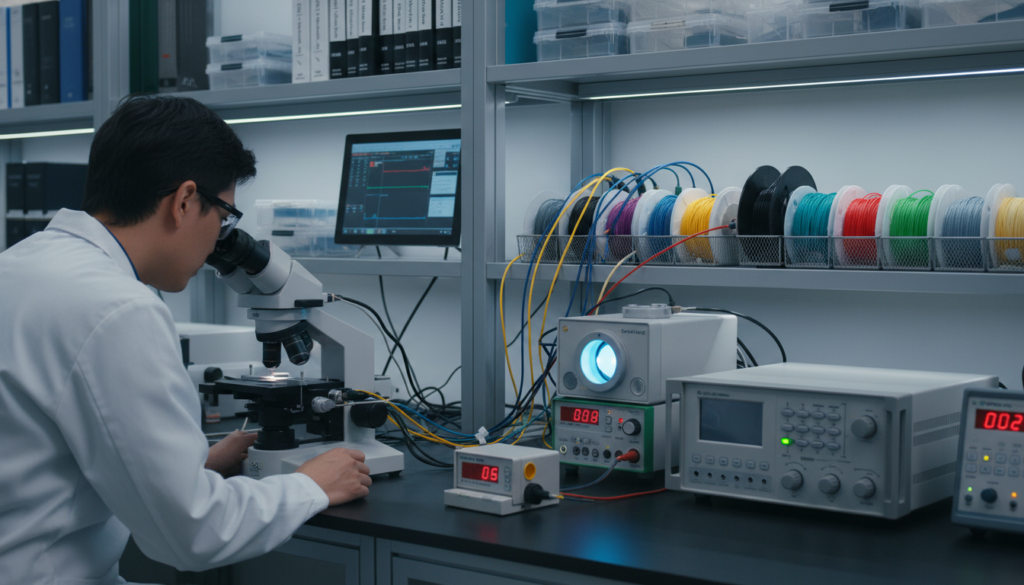
Every optical fiber has its own set of properties that decide its best use. When picking fibers for certain tasks, knowing their specifications is key. Even small differences in performance can greatly affect an optical system’s success.
Matching the core diameter is very important. A mismatch, like between 62.5 µm and 50 µm, can cause big signal losses. Single-mode fibers need precise mode field diameter specifications for light to travel right at certain wavelengths.
Bend radius limits help fibers avoid signal loss and mechanical failure. Standard telecom fibers can handle about 500 mW of power. But, special fibers can manage even more power with air-gap designs or protective end-caps.
Environmental performance varies a lot among fiber types:
- Standard temperature range: -40°C to +85°C
- High-temperature custom fibers: exceed 300°C
- Radiation resistance: up to 10 kGy for nuclear and space use
- Mechanical strength for industrial vibration and cable pulling
“The right fiber specifications can extend equipment life by decades while the wrong choice leads to early failure and costly replacements.”
These fiber properties greatly impact installation costs, maintenance, and system reliability. Engineers must carefully choose fibers based on application needs. This ensures optical networks work well under different conditions.
The Manufacturing Process of Specialty Fibers
The journey of making specialty fibers begins with a detailed plan. Engineers and clients work together to figure out what’s needed. They consider things like how hot it can get, how much stress it can handle, and how much data it can carry.
Choosing the right materials is key to making high-quality fibers. Suppliers like Corning or Heraeus provide ultra-pure silica glass. To change the fiber’s light properties, germanium or fluorine is added. The core of the fiber is built up layer by layer using vapor deposition.
The drawing tower is where solid preforms turn into thin fibers. The glass is heated to 2,000°C, making it soft and stretchy. This process shapes the fiber to the right size. Right after, a coating is applied to protect the fiber. Each coating has its own job – like keeping moisture out or adding strength.
| Production Stage | Temperature Range | Critical Parameters |
|---|---|---|
| Preform Heating | 1,900-2,100°C | Uniformity ±2°C |
| Fiber Drawing | 1,850-2,000°C | Diameter tolerance ±1μm |
| Coating Application | 25-80°C | Thickness 62.5μm |
| Curing Process | 150-200°C | UV exposure 600 mJ/cm² |
Every batch of fibers goes through quality checks. Machines test how well the fibers carry signals, how strong they are, and how well they bend. They also test how they do in extreme conditions. The final step is packaging the fibers safely for transport to where they’ll be used.
Environmental Considerations in Fiber Manufacturing
Modern specialty fiber production has become very green. Factories now use smart strategies to make quality products while caring for the planet. Energy use in high-temperature drawing has dropped by up to 40% thanks to new heating tech and better schedules.
Big names like Corning and Prysmian Group set high environmental standards. Their factories use smart tech for clean and controlled environments. They also use systems to reuse waste heat from towers in other parts of the factory.
| Environmental Initiative | Impact Reduction | Implementation Cost |
|---|---|---|
| LED Cleanroom Lighting | 65% energy savings | $50,000-100,000 |
| Heat Recovery Systems | 30% heating reduction | $200,000-400,000 |
| Water Recycling | 80% water reuse | $150,000-300,000 |
| Chemical Waste Treatment | 95% waste reduction | $500,000-1,000,000 |
Being efficient with materials is key in green fiber making. Using precision coating cuts down chemical use by 25%. Recycling turns factory scraps into new raw materials. ISO 14001 helps keep these green standards the same worldwide. Next steps include using bio-based coatings and making factories carbon-neutral.
The Future of Specialty Fiber Manufacturing
The world of specialty fiber making is changing fast. New future fiber technology lets us do things we couldn’t before. For example, photonic crystal fibers guide light in ways old fibers can’t.
This breakthrough is leading to new ways to send messages and explore deep seas. It’s making things that seemed like science fiction just a few years ago possible.
AI is changing how fibers are made at places like Corning and Fujikura. Machines can spot tiny flaws right away. They also predict when equipment might break, fixing problems before they start.
Smart sensors watch over every step of making fibers. They adjust things on the fly to keep fibers perfect.
One big trend is multi-core fibers. They have many light paths in one fiber, carrying more data without needing thicker cables. Already, space and underwater projects are using these fibers.
| Technology Area | Current Status | Expected by 2030 |
|---|---|---|
| Photonic Crystal Fibers | Limited production | Mass manufacturing |
| AI Quality Control | 30% adoption | 85% adoption |
| Multi-core Designs | 4-7 cores | 19+ cores |
| Quantum Applications | Research phase | Commercial deployment |
Digital changes aren’t just for making fibers. Now, we track materials from start to finish. This ensures quality at every step.
Also, making custom fibers is much faster. What used to take months now takes just days. This quick turnaround helps the whole optical field innovate faster.
Key Players in the Specialty Fiber Market
The specialty fiber industry is led by top optical fiber factory leaders. They innovate and manufacture, serving many industries. This includes telecommunications and data centers.
Corning Incorporated leads with its low-loss fiber technology. Their products are used in telecom networks and data centers globally. Prysmian Group offers a wide range of fiber solutions, from home cables to submarine systems. They have facilities worldwide to meet demand.
Asian manufacturers are becoming more important. Yangtze Optical Fibre and Cable (YOFC) is Asia’s largest supplier. They make everything from preforms to cable assemblies. Hengtong Group provides high-fiber-count solutions for backbone networks. Sumitomo Electric Industries has decades of experience in long-distance and metro networks.
| Company | Specialization | Market Focus |
|---|---|---|
| Corning | Low-loss fiber technology | Telecom & Data Centers |
| Prysmian | FTTH to submarine cables | Global Infrastructure |
| YOFC | Integrated manufacturing | Asia Pacific |
| OFS (Furukawa) | Ruggedized outdoor cables | Industrial Applications |
| CommScope | Enterprise connectivity | Data Centers |
Nexans and Sterlite Technologies expand their reach through partnerships. OFS makes cables for tough environments. CommScope focuses on data center and enterprise connectivity. Each company adds unique skills to the industry.
Case Studies in Optical Applications
Real-world fiber factory applications show how important specialty fibers are. They connect continents and save lives. These technologies are changing our world in amazing ways.
In optical telecommunications, companies like Corning and Prysmian Group make single-mode fibers. These fibers help AT&T and Verizon send data over long distances without losing the signal. Metro networks use both single-mode and OM4 multimode fibers. This supports Google Fiber’s fast internet for millions of homes.
Medical fiber systems are changing patient care in big ways. Olympus and Karl Storz make endoscopes with flexible fiber bundles. These allow doctors to do surgeries without big cuts, cutting recovery times down.
Boston Scientific uses high-power laser fibers for heart treatments. They treat irregular heartbeats with great precision.
| Application Type | Fiber Specification | Primary Use | Leading Manufacturer |
|---|---|---|---|
| 5G Backhaul | G.657.A2 | High-capacity data transport | CommScope |
| Surgical Lasers | 600μm core | Tissue ablation | Lumenis |
| Dental Systems | 200-400μm core | Soft tissue procedures | Biolase |
| Aerospace Monitoring | Radiation-resistant | Engine diagnostics | Luna Innovations |
Industrial monitoring takes fiber technology to extreme limits. Weatherford International uses temperature-resistant fibers in hot geothermal wells. Nuclear facilities use AFL Telecommunications’ radiation-hardened fibers for reactor surveillance in tough environments.
Conclusion: The Future of Specialty Fibers in Optical Manufacturing
The future of precision fiber plants is promising. Manufacturers are meeting the need for high-performance fibers and new uses. Companies like Corning, Prysmian, and YOFC are leading the way with automation and AI.
These technologies help make fibers that can handle tough conditions while keeping quality high. The industry is also moving towards quick customization. This means making specialized products for things like quantum communications and deep-space exploration.
Specialty fiber innovation is key to creating new designs and structures. This includes multi-core fibers and photonic crystal structures. These advancements help fibers carry more data faster.
Research teams and manufacturers are working together to solve problems. Companies like VRGHT offer custom solutions that meet customer needs without breaking the bank.
Environmental concerns are also shaping the industry. Factories are now using energy-efficient methods and eco-friendly materials. The goal is to keep advancing technology while protecting the environment.
As our needs for bandwidth grow, so does the need for new solutions. The collaboration between suppliers, researchers, and users ensures that fiber innovation keeps up with our changing world.
FAQ
What makes an optical fiber factory different from standard cable manufacturing facilities?
An optical fiber factory needs special cleanrooms and high-temperature towers. These towers heat the fiber to over 2000°C. They also have advanced quality control systems to check light transmission at the nanometer scale.
Unlike regular cable making, making specialty fibers involves complex processes. These include chemical vapor deposition and precise doping of quartz with rare-earth elements. The core diameter must be controlled to microns.
These facilities use special testing equipment. This equipment checks optical properties like attenuation and bandwidth. These properties are not found in regular cable production.
How does the fiber production process ensure consistent quality across thousands of kilometers of fiber?
The process uses automated systems to control drawing speed, temperature, and tension. Real-time optical testing checks attenuation levels every few seconds. Diameter control systems keep tolerances within ±0.5 microns.
Companies like Corning and YOFC use AI for quality control. This AI detects anomalies and adjusts parameters automatically. The preform preparation stage ensures uniformity through precise chemical vapor deposition.
What environmental controls are necessary in a precision fiber plant?
A precision fiber plant needs Class 1000 or better cleanroom conditions. This prevents contamination that could cause signal loss or mechanical weakness. Temperature control maintains ±0.5°C stability in drawing areas.
Humidity levels stay between 40-60% to prevent static buildup and coating issues. HEPA filtration systems remove particles larger than 0.3 microns. Positive pressure prevents outside contaminants from entering production areas.
Vibration isolation protects sensitive drawing equipment. Specialized air handling systems prevent chemical vapors from affecting other production stages.
How do manufacturers handle the extreme temperatures involved in specialty fiber production?
Fiber drawing furnaces operate at temperatures between 1900-2200°C. Manufacturers use graphite or iridium heating elements in inert atmospheres to achieve these temperatures without oxidation. The drawn fiber experiences rapid cooling from over 2000°C to room temperature within seconds.
For specialty high-temperature fibers, manufacturers apply metal or polyimide coatings immediately after drawing. This is done while the fiber is warm. Advanced cooling systems use helium gas for rapid, uniform temperature reduction without introducing mechanical stress.
What quality testing occurs during the manufacturing process?
Throughout production, fibers undergo continuous optical time-domain reflectometry (OTDR) testing. This detects any discontinuities or loss variations. Geometric measurements verify core/cladding concentricity within 0.5 micron tolerances using laser-based systems.
Tensile strength testing samples fibers at regular intervals. This ensures they can withstand installation forces exceeding 600 MPa. Environmental testing subjects fiber samples to temperature cycling, humidity exposure, and radiation exposure up to 10 kGy.
Bandwidth measurements confirm transmission capacity meets specifications. This is for both single-mode and multimode fibers at their designed operating wavelengths.
How do manufacturers customize fibers for specific applications like medical or aerospace use?
Customization begins with detailed requirement analysis of the application environment. This includes temperature ranges, radiation exposure, and mechanical stress conditions. For medical applications, manufacturers like OFS produce fibers with biocompatible coatings and specific core sizes optimized for laser wavelengths used in surgery.
Aerospace applications require fibers from companies like Prysmian. These fibers incorporate radiation-resistant dopants like cerium and use polyimide coatings stable to 300°C. The preform design phase adjusts refractive index profiles, core diameter, and numerical aperture to meet specific transmission requirements.
Multi-parameter optimization balances dispersion characteristics, bend loss tolerance, and power handling capabilities. This is done through iterative design using advanced simulation platforms.
What are the main challenges in scaling up specialty fiber production?
Scaling production while maintaining ultra-tight tolerances presents significant challenges. Even minor variations in temperature or drawing speed can affect kilometers of fiber. Raw material consistency becomes critical when sourcing high-purity quartz and specialized dopants in larger quantities.
Equipment calibration and maintenance schedules must balance maximum uptime with the precision required for specialty products. Workforce training requires extensive technical expertise. Operators must understand both the physics of light propagation and complex chemical processes.
Market demand fluctuations for specialty fibers make it difficult to optimize production runs. This is true for custom products requiring unique preform designs. Investment in advanced manufacturing equipment like MCVD systems and drawing towers can exceed million per production line.
How do manufacturers ensure fiber compatibility with existing network infrastructure?
Manufacturers follow international standards like ITU-T G.652 for single-mode and TIA-568 for multimode fibers. This ensures compatibility. Mode field diameter matching prevents excessive loss when connecting fibers from different manufacturers.
Connector polishing standards (PC, UPC, or APC) are strictly adhered to. Angle measurements are verified to ±0.2 degrees for APC connectors. Backward compatibility testing ensures new fiber designs work with legacy equipment, which is important for network upgrades.
Companies like CommScope and Nexans provide compatibility matrices. These matrices show which fiber types can be safely interconnected without exceeding loss budgets.
Explore
IVG fiber technologies