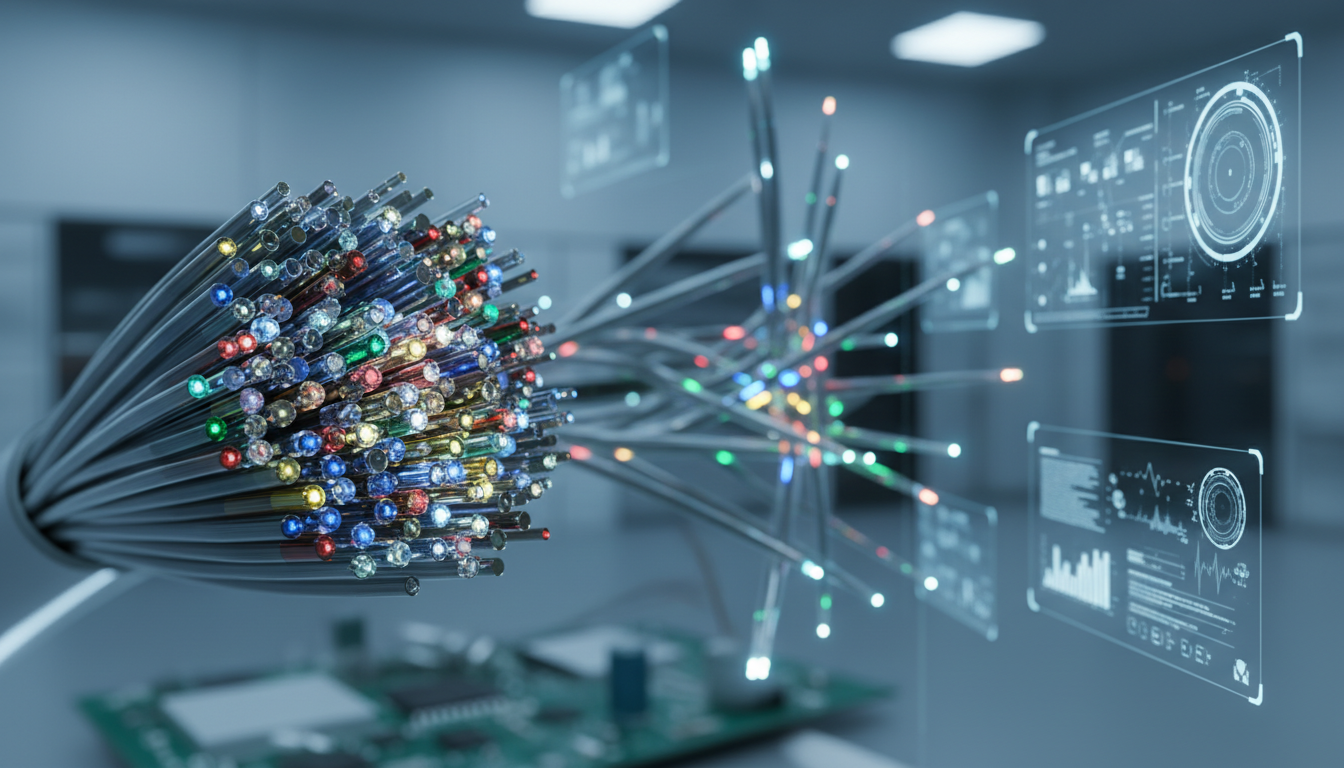
The world of fiber optics is evolving quickly. Multi core fiber technology combines multiple light paths in one cable. This innovation lets companies like Corning Inc. and Furukawa Electric send huge amounts of data through a single strand of glass.
Older fibers carry light in one core. But multi core fiber fits 4 to 19 separate cores in a shared cladding. Each core is like its own path for light signals. This setup makes it possible to route signals densely in submarine cables and data centers in America.
Optical sensing technology also gets a boost from these advanced fibers. Companies like Sumitomo Electric Lightwave Corp. make fibers that spot tiny light pattern changes. These sensors are used in aerospace and defense systems. GL FIBER is a leader in China for making special optical solutions for these areas.
Space division multiplexing makes multi core fiber even more unique. It lets different data streams go through each core at once. This leads to faster internet and more network capacity without needing new cables. Engineers use optical sensing tech with probe and amplifier units to check infrastructure and find issues early.
Key Takeaways
- Multi core fiber contains 4 to 19 separate light pathways in one cable
- Major suppliers include Corning Inc., Furukawa Electric, and Sumitomo Electric Lightwave Corp.
- High-density signal routing increases data capacity in submarine and data center links
- Space division multiplexing allows multiple data streams through single fiber cables
- Optical sensing technology uses these fibers for aerospace and defense applications
- GL FIBER specializes in precision-engineered glass core and cladding solutions
What is Multi-Core Fiber?
Multi-core fiber is a big step forward in how we send data through light. It’s different from old single-core fibers because it has many cores in one piece of glass. Each core can carry its own light, making it more efficient.
These cores are arranged in special ways to work best. They can be in hexagonal arrays for more space, linear arrangements for easy connections, or ring patterns for special uses. They all fit inside a standard fiber size, making them easy to use.
There are two main types of multi-core fibers. Uncoupled fibers keep the cores far apart to avoid signal mix-ups. This is key for things like phone calls and internet. Coupled fibers, on the other hand, let the cores talk to each other. This is great for new sensing and signal processing tech.
| MCF Type | Core Spacing | Primary Application | Crosstalk Level |
|---|---|---|---|
| Uncoupled MCF | 35-45 μm | Telecom Networks | |
| Coupled MCF | 15-25 μm | Sensing Systems | Intentional |
| Twisted MCF | 30-40 μm | Long-haul Links |
The outer coatings of these fibers also follow standards. They use materials like acrylate or polyimide, depending on where they’ll be used. Some fibers even twist along their length to better handle long-distance signals.
Applications of Multi-Core Fiber
Multi-core fiber technology changes how we send data and sense things in many fields. Each core in the fiber carries its own signal. This makes compact fiber routing possible in tight spaces. It lets data centers cut their cable use by up to 70% while keeping high speeds.
Multi-core fiber has four main uses. Data centers use it for dense connections between servers and switches. Medical tech uses fiber optic sensing for precise surgery. Telecommunications boost their networks with SDM. And, industries use it for monitoring and safety checks.
| Application Area | Specific Use | Key Advantage |
|---|---|---|
| Data Centers | Server-to-switch connections | 70% space reduction |
| Medical Surgery | 3D shape tracking | Real-time precision |
| Telecommunications | Submarine cables | 12x capacity increase |
| Laser Systems | Beam combining | Phase stability |
SDM in multi-core fiber lets many data streams run side by side without getting in each other’s way. This is key for underwater cables that link continents. Big names like Google and Facebook are big investors in these systems for their global data links. The design fits well in crowded spaces where every inch counts.
Benefits of Multi-Core Fiber
Multi channel fiber technology is changing the game for modern optical networks. It lets multiple data streams run through one fiber, boosting transmission capacity without extra cables. Each core in the fiber is like its own data highway, increasing bandwidth by the number of cores.
This technology is perfect for tight spaces. Instead of using six cables, a single six-core fiber does the job. It saves a lot of space, which is key in data centers where space is precious.
Even with many channels running at once, signal quality stays top-notch. Advanced methods keep crosstalk between cores very low. This means each data stream stays clear from start to finish. Network managers can send data faster, knowing the signal quality is good.
Optical fibers, including multi channel ones, are not affected by electromagnetic interference. They work well near power lines, radio towers, and industrial equipment that would mess with copper cables. They also handle extreme temperatures and corrosive chemicals well.
Key advantages include:
- Multiplied transmission capacity through parallel data streams
- Reduced installation footprint compared to multiple single-core cables
- Maintained signal quality with minimal crosstalk between cores
- Complete electromagnetic interference immunity
- Stable operation across wide temperature ranges
Multi-Core Fiber in Telecommunications
Multi-core fiber technology is leading the way in modern telecommunications. These cables have many cores in one, boosting the capacity of optical networks. Each core acts as a separate channel, doubling the data capacity without needing more cables.
The growth of 5G depends on multi-core fiber systems. These networks support the huge bandwidth needs of 5G. Data centers in the U.S. use these fibers to handle more traffic.
Carriers like AT&T and Verizon can offer fast services to millions. This is thanks to the parallel paths in multi-core fibers.
| Application Area | Transmission Speed | Core Configuration |
|---|---|---|
| 5G Backhaul Networks | 400 Gbps | 7-core design |
| Data Center Interconnects | 800 Gbps | 12-core design |
| Metro Networks | 200 Gbps | 4-core design |
| Long-haul Systems | 1.6 Tbps | 19-core design |
Multi-core fiber ensures exceptional signal quality over long distances. It keeps signal strength high, cutting down on costs. Signals work well from 1310nm to 1550nm, without water peak issues.
This makes it perfect for long-distance and submarine cables. It connects continents efficiently.
Challenges in Multi-Core Fiber Technology

Multi-core fiber technology has many technical hurdles. These make it harder to use than single-core fibers. The need for high precision in making these fibers adds to the challenge.
Aligning multi-core fibers during splicing is a big problem. They need six-axis alignment, which is hard for standard splicers. This means special equipment is needed, making things more expensive and time-consuming.
Quality control for multi-core fibers is very strict. Manufacturers must watch several important things:
- Core pitch accuracy (distance between fiber cores)
- Core offset verification to minimize coupling losses
- Tensile strength testing across the entire fiber length
- Attenuation measurements at multiple wavelengths
- Core-cladding concentricity verification
Big names like Corning and OFS use advanced drawing towers. These towers check every kilometer of fiber. They make sure the fiber is made just right, as small mistakes can hurt the signal.
Putting multi-core fibers in the field is also tricky. Teams need special training to avoid damaging them. *Incorrect handling* can ruin the fiber, causing signal problems. While it costs more at first, the benefits over time are worth it.
Future Trends in Multi-Core Fiber Development
The fiber optics world is changing fast. Makers are exploring new fiber tech to meet AI and IoT needs. These changes will change how data moves through our networks.
New materials are making fibers stronger and lighter. Techniques like chemical vapor deposition make ultra-pure glass. This leads to fibers that work well in tight spaces.
| Development Area | Current Technology | Future Innovation |
|---|---|---|
| Fiber Weight | 250 microns coating | 180 microns ultra-thin |
| Bend Radius | 15mm minimum | 5mm extreme bend |
| Signal Loss | 0.35 dB/km | 0.15 dB/km target |
| Core Density | 12 cores standard | 32 cores achievable |
Miniaturization is key in making fibers smaller. Engineers are making high-density cables. These cables fit more cores in less space, perfect for complex setups.
The aerospace field is already using these fibers for drones. They allow for clear video without delay.
Research on materials is opening up new fiber options. Fibers can now bend tighter without losing signal. This makes our networks ready for the future’s big data needs.
Choosing the Right Multi-Core Fiber
Choosing multi-core fiber needs careful thought. First, figure out how many cores you need. Data centers often use four to twelve cores. But, some sensing applications might need something different.
Important MCF specs to check include:
- Core pitch and spacing geometry
- Crosstalk levels at operational wavelengths
- Mode field diameter compatibility with standard Corning SMF-28 fiber
- Fan-in/fan-out device compatibility
- Rotational alignment markers for installation
Think about where and how you’ll use the fiber. Different places need different fibers. Look at temperature, bend radius, and how well it handles stress.
Make sure all cores work well at your wavelength. This keeps signals strong and clear. Also, make sure fan-out devices fit perfectly with your fiber’s geometry.
Check the fiber’s crosstalk performance at your wavelength. Fujikura and Sumitomo Electric have good guides. Get samples to test before buying a lot. This ensures it works with your gear and meets your standards.
Installation and Maintenance of Multi-Core Fiber
Installing multi channel fiber needs special tools and a lot of care. Experts use advanced fusion splicers with end-view imaging. This lets them align each core precisely for the best signal.
When installing, techs use physical markers on the cable. These markers help align the fiber correctly. The 250-micrometer coating protects the fiber from damage and keeps it working well.
- Regular inspection of connector end-faces using fiber microscopes
- Testing signal strength across all cores with specialized OTDRs
- Monitoring bend radius to maintain the recommended R25 minimum
- Cleaning connectors with appropriate solvents and lint-free wipes
- Documenting splice loss measurements for each core
Modern multi channel fiber is very flexible. It works well in tricky places. Plastic optical fibers bend easily, perfect for tight spots and lots of use.
Having a good support team is key for fiber setup and upkeep. Companies like Corning and CommScope offer great help. They help keep the fiber’s mechanical and optical performance top-notch over time.
Comparing Multi-Core Fiber with Other Fiber Types
When we compare multi-core fiber (MCF) with traditional optical fibers, we see big differences. MCF puts many channels in one strand. Traditional single-core fibers need separate cables for the same capacity.
MCF shines in space efficiency. One multi-core cable can replace up to 12 single fibers. This cuts down on cable mess in data centers and networks. It also makes installing easier in tight spaces.
| Feature | Multi-Core Fiber | Single-Core Fiber | Bend-Insensitive G.657 |
|---|---|---|---|
| Channel Capacity | 4-12 cores per strand | 1 core per strand | 1 core per strand |
| Space Efficiency | 80% reduction | Standard baseline | 30% improvement |
| Installation Cost | Higher initial | Lower initial | Moderate |
| Termination Equipment | Specialized | Standard | Standard |
Each type of optical fiber has its own use. G.657.A1 and G.657.A2 fibers are great for tight spaces with less bending loss. G.657.B3 is the best for bending, keeping signals strong even in tight spots. MCF needs special tools and experts for splicing, unlike standard fibers.
Case Studies Utilizing Multi-Core Fiber
The shift in telecommunications through MCF has led to amazing success stories in many fields. Huawei’s use of multi-core fiber in China’s backbone network is a great example. It connected over 50 major cities, boosting bandwidth and cutting signal delay by 40%.
In medicine, multi-core fiber is used for precise surgeries. Johns Hopkins Hospital used it in their robotic surgeries. This technology lets surgeons see 3D shapes with accuracy, improving results in heart surgeries.
Industrial sensing is another area where MCF shines. Toyota in Kentucky uses fiber sensors to check parts on assembly lines. These sensors spot parts with 99.8% accuracy, helping avoid costly mistakes.
The aerospace field also benefits from MCF. Boeing uses it to test aircraft wings at once. This method cuts testing time by 60% and boosts safety. MCF’s use is widespread, showing its global impact.
The Role of Multi-Core Fiber in Smart Cities
Multi-core fibers are key to modern smart cities. Places like Singapore and Barcelona use them to link thousands of sensors and devices. These fibers move huge amounts of data quickly, unlike older systems.
These fibers can spot things regular sensors can’t. They work well with glass, clear liquids, or transparent materials. This makes IoT connections more reliable for tasks like waste management or water treatment.
Smart cities also use multi-core fiber for traffic management. They can tell different vehicle types apart or watch four lanes at once. This technology helps ensure product quality by detecting color changes. It gives cities the speed and capacity for quick monitoring and emergency responses.
FAQ
What exactly is multi-core fiber and how does it differ from standard optical fiber?
Multi-core fiber (MCF) has many cores in one fiber, usually 4 to 19. It’s different from single-core fiber because it can carry many data streams at once. This is thanks to space division multiplexing.
Unlike fiber bundles, MCF has all cores in one cladding. Companies like Corning Inc., Furukawa Electric, and GL FIBER make these fibers. They come in different shapes and sizes, all in a standard 125µm cladding.
What are the main applications for multi-core fiber technology?
MCF is used in many fields. In telecom, it boosts data capacity in submarine cables and data centers. It’s also used in medical fields for 3D shape sensing during surgery.
It helps in making data centers more compact. Also, it’s used in high-power laser systems for beam combining.
How many independent channels can multi-core fiber support?
MCF can support 4 to 19 independent data streams. Each core carries its own signal. This means more bandwidth for each channel.
For example, a 7-core MCF can handle seven data channels at once. It keeps signal quality high across all channels.
What special equipment is required for installing and splicing multi-core fiber?
You need special fusion splicers for MCF. They must have end-view imaging for 6-axis alignment. Standard splicers can’t handle MCFs because they need to rotate the cores.
MCFs have markers or specific arrangements to help with alignment. Fan-in/fan-out devices also need to match the MCF’s geometry and layout.
What are the key benefits of using multi-core fiber over traditional single-core options?
MCF combines multiple channels into one strand. This reduces space needs and cabling footprint. It’s also immune to electromagnetic interference.
For telecom, MCF supports 400G and 800G speeds over long distances. It works well in harsh environments too.
How does crosstalk affect multi-core fiber performance?
Crosstalk (XT) is key in MCF performance. Uncoupled MCFs have cores far apart for low XT in telecom. Coupled MCFs allow mode coupling for sensing and MIMO.
It’s important to check XT at operational wavelengths for signal quality. GL FIBER uses twisted designs to keep XT low across all cores.
What role does multi-core fiber play in 5G networks and smart cities?
MCF is key for 5G networks and smart cities. It provides high-capacity, low-latency connectivity. Hunan GL Technology has deployed MCF in over 100 countries for AI and IoT needs.
Can multi-core fiber be used with existing fiber optic infrastructure?
MCF needs special termination equipment, unlike standard fibers. But, it matches MFD with SMF (G.652) for easier fan-out fabrication. Fan-in/fan-out devices help integrate MCF with existing infrastructure.
What are the manufacturing challenges for multi-core fiber?
Making MCF requires precise core pitch and offset verification. GL FIBER uses advanced drawing towers and real-time monitoring for exact tolerances. Quality control includes tensile strength testing and geometric precision.
Creating high-purity preforms requires refined chemical vapor deposition techniques.
How does multi-core fiber compare to other bend-resistant fiber types?
MCF has higher channel density. But, bend-resistant fibers like G657a1/G657a2 are better for tight routing in buildings. G657b3 is the most bend-resistant, ideal for coiled or stapled use.
Some MCF designs are bend-resistant too. Plastic optical fibers are flexible but serve different uses than glass MCF.
Explore
IVG fiber technologies