
pack more performance into less space without sacrificing reliability.
Multi-Core Fiber for High-Density Optical Architectures
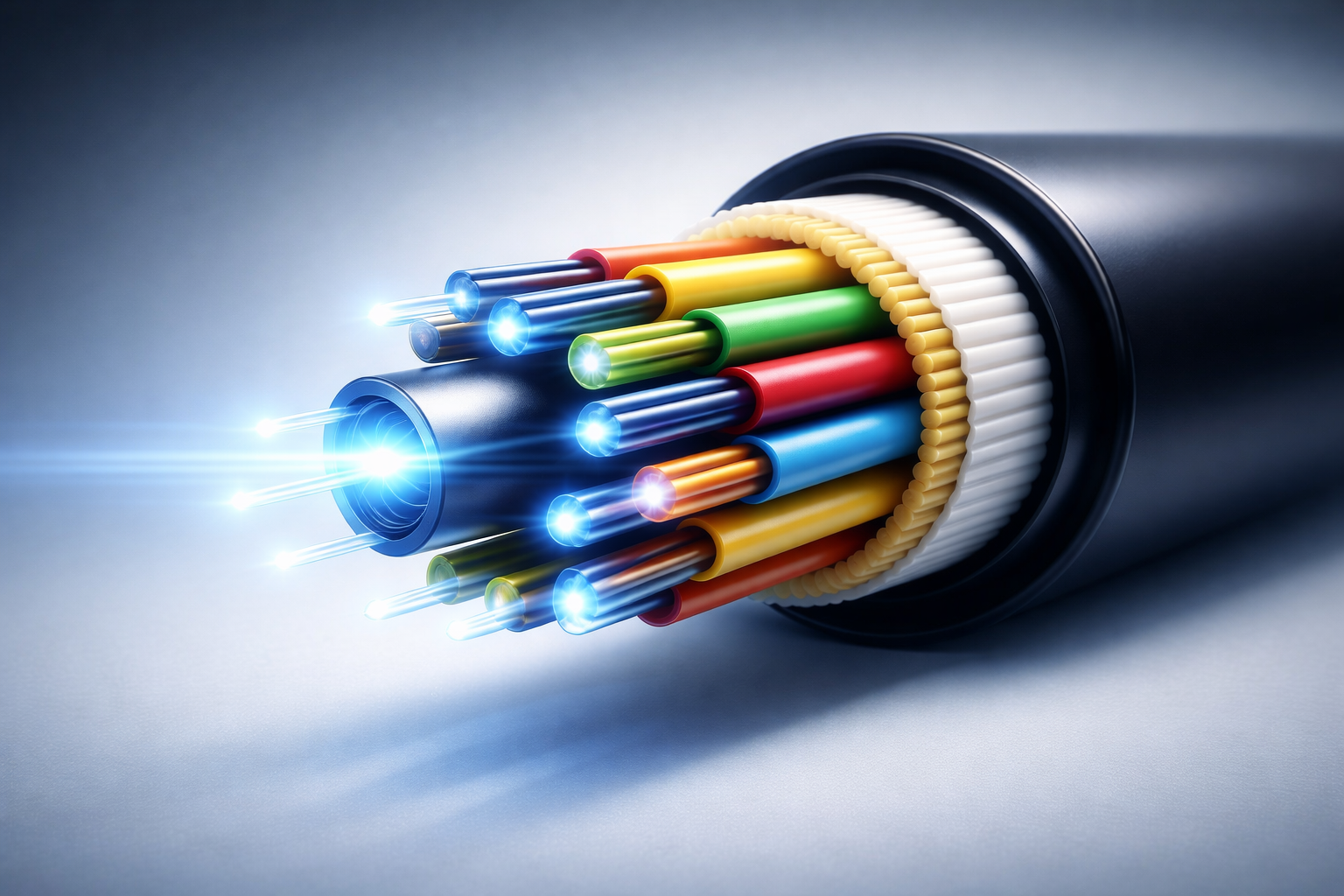
Our multi-core fiber integrates multiple independent optical cores in a 1+3 or 1+6 configuration, allowing for precise position and direction sensing with a single probe or conduit. It’s an innovative tool for multiple applications, where size and spatial resolution are critical without compromising optical performance or reliability.
Our multi-core fibers are manufactured with extreme precision to ensure core-to-core isolation, dimensional stability, and uniform optical behavior across every channel. They deliver unmatched performance in advanced medical instruments and next-generation communication platforms.
Key advantages:
-
Higher channel density in minimal space
-
Reduced cabling volume and weight
-
Improved mechanical robustness
-
Simplified system architecture
-
Lower total system cost
Why Multi-Core Fiber Defines Next-Generation Optical Design
Multi-core fiber enables new levels of system integration by allowing multiple independent optical paths in one physical fiber. It is the foundation of compact photonic platforms and advanced sensor arrays where spatial efficiency and performance scalability are mandatory.
Ideal for:
Core Geometry Precision
Each core is positioned and dimensioned with high-accuracy tooling to maintain identical optical properties and stable core-to-core separation across the entire fiber length.
Certified Specialty
Fiber Manufacturing
Produced under certified quality systems with optional optical mapping, geometry inspection, full production traceability for industrial, scientific compliance.
Fiber Engineered for Predictable Performance
Every multi-core fiber is manufactured using digitally controlled drawing and core placement technology. Core geometry, spacing, and refractive index profiles are maintained with sub-micron precision to ensure consistent optical behavior and long-term system stability.
This guarantees:
Multi-Core Fiber Specifications Overview
Multi-core fiber is fabricated by embedding multiple optical cores into a single cladding structure, enabling simultaneous multi-channel transmission with exceptional compactness and structural integrity.
Available Fiber Types
-
2-core to 12-core configurations
-
Single-mode and mixed-mode designs
-
Metal-coated multi-core fiber
-
Custom core spacing and layouts
-
Hybrid sensing and signal fibers
Technical Performance Summary
| Parameter | Spun Fiber Specification |
|---|---|
| Fiber Structure | Multiple independent cores in single cladding |
| Core Count Options | 2 to 12 cores (custom configurations available) |
| Core-to-Core Crosstalk | < −40 dB typical |
| Operating Temperature | −60 °C to +300 °C (higher with metal coatings) |
| Optical Attenuation | ≤ 0.25 dB/km @ 1550 nm |
| Tensile Strength | > 450 MPa |
| Bend Radius | ≥ 25× fiber diameter |
| Core Position Accuracy | ±0.5 μm |
| Chemical Resistance | Compatible with industrial oils and solvents |
| Coating Options | Polyimide, metal, composite |
| Channel Uniformity | < ±1% optical variation between cores |
| Mechanical Fatigue Resistance | High, optimized for compact installations |
| Length Availability | From meters to multi-kilometer production |
| Dimensional Stability | Excellent under thermal cycling |
| Production Traceability | Full batch and process documentation |
| Compliance Options | ISO manufacturing, application-specific testing |
FAQ’s
Yes. Core count, spacing, coatings, geometry, and optical parameters are fully customizable.
By integrating several cores into one fiber, it minimizes cabling volume, connector count, and routing complexity.
With appropriate coatings such as metal or polyimide, multi-core fiber performs reliably under vibration, heat, and chemical exposure.
Multi-core fiber is used when multiple optical channels are required in a compact space. It replaces fiber bundles with a single robust structure.
